|
Media control and censorship! |
The mind-bending power of the masters of the media
The media-power in Great Britain and elsewhere
The Mind-Benders is an analysis of the media power in Great Britain. Written in 1997, it details how (and why) the information we receive via the media is censored and distorted. If we are to avoid insidious totalitarianism we must be aware of the enormous control over every form of mass media the Jews possess and – in any democratic society under such powerful influences – who are the real manipulators of political power.
Who controls what we read?
Although the printed word is no longer as powerful as it once was, and although the broadcasting media are now the most important factor in shaping general popular attitudes, the owners, editors and journalists of national newspapers still have immense power. In particular, it is the national newspapers which decide the issues on which elections will, and will not, be fought. Press coverage is still the key factor which makes or breaks politicians, and which sets the parameters of ‘acceptable’ political thought. The national newspapers have long been termed the “Fourth Estate,” but even this phrase under-estimates their power. It is in truth no exaggeration to say that whoever controls the press controls the political direction of the nation.
The Jewish presence in the press is not as all-pervading as it is in the broadcast media. But such is the cowardice of the vast majority of the intellectual prostitutes known as journalists, that it seems that Organised Jewry is able to impose its line on the British press by rather more remote control than in the case of television. Having said which, the number of Jews in key positions in the tangled web of newspaper ownership and production is still out of all proportion to their numbers in the British population as a whole.
The same can be said of publishing generally, with the additional factor that many publishing houses are owned by Jewish-owned companies based in the USA.
The Press
Associated Newspapers
As well as owning the Daily Mail and London Evening Standard, Associated Newspapers has a one-fifth stake in the TV news company ITN, owns 20 per cent of the ITV company Westcountry TV, 14 per cent of Selec TV and nearly half of Teletext.
|
One of Associated Newspapers’ major players is Stewart Steven – real name Stefan Gustaf Cohen. Having come to Britain in 1941 as a six-year-old refugee, Steven was appointed Assistant Editor of the Daily Mail in 1972, going on to edit the Mail on Sunday in 1981, before becoming Editor of the Evening Standard. He is a Director of Associated Newspapers Holdings Ltd, Mail Newspapers plc., and The Mail on Sunday. Steven boasts of his influence on the British Government that “every member of the Government knows me by my Christian (sic) name.” The Managing Director and Managing Editor of the Daily Mail are Guy Zitter and Lawrence Sear, while the Editor of the Mail on Sunday is Jonathan Holborrow. A study of a randomly chosen day’s issue of the Mail suggests that Jews make up nearly a third of its journalists (excluding writers for the politically irrelevant sports pages, who are invariably Gentiles) – including Middle East specialist Paul Harris, Geoffrey Levy, Richard Kay, Jonathan Margolis, Sam Harris, Sarah Ebner and Gaby Hinsiff. |
|
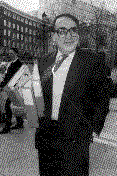
Anne Applebaum is Associate Editor of the London Evening Standard, as well as writing regularly for the Daily Mail and Sunday Telegraph. When Evening Standard columnist Matthew Norman criticised Tory Home Secretary Michael Howard for agreeing to legislation “that would have deprived his father of sanctuary in Britain,” he did so in such extreme terms that Gerald Jacobs was moved to write a piece in the Jewish Chronicle criticising Jewish hypersensitivity and the “psychological condition” which “sees any public criticism of Jews by Jews as fuel for Gentile scorn and anti-Semitism. That way real madness lies.”
Another Evening Standard reporter, Mark Honigsbaum, penned a remarkably indiscreet article for the paper’s ‘London Life’ feature on 21 January, 1992. Headlined “The TV Clique,” its sub-heading told readers that:
“David was at school with Michael who plays snooker with Charles who knows Alan who is a friend of Michael. Together these five men form a powerful group who have a massive influence on what you will be watching on television today.”
The five referred to are David Elstein, Michael Grade, Charles Saatchi, Alan Yentob and Michael Green.
|
Another Associated bigwig is Clive Wolman, founder and Editor-in-Chief of the weekly magazine London Financial News and formerly Editor of the Mail on Sunday City edition. Wolman cut his journalistic teeth editing the Oxford University magazine Isis, before spending two years in Israel working on the Jerusalem Post. Among the backers of Wolman’s venture are his long-standing friend Anthony Julius – the Princess of Wales’s lawyer and author of a vicious attack on the great poet T. S. Eliot, whom he regards as ‘anti-Semitic’– and Lawrence Lever, financial columnist at the Mail on Sunday. At a Jewish Chronicle-sponsored meeting in March 1996, Lever spoke of the personal unease with which he sometimes approached reporting on Jewish businessmen who had acted illegally or unethically. |
|
The new magazine – aimed at stockbrokers, fundmanagers, corporate financiers and traders – is distributed on the internet by the online business information company, MAID, whose Chief Executive is Dan Wagner. A £500,000 launch campaign was conducted by publishing director Gary Stern – a Young Jewish Care leader – who also invested his own capital in the venture.
News Group International
NGI’s assets include the lion’s share of BSkyB, Twentieth Century Fox and major British newspapers such as The Sun, News of the World, The Times, the Sunday Times and the Times Literary and Educational Supplements. Its Chief Executive, Rupert Murdoch, is usually regarded as a Gentile, although he has been described as a ‘mamzer Jew.’ His father, Keith, although only a low-paid reporter, made a fortuitous marriage to the daughter of a wealthy Jewish family, Elisabeth Joy Greene. The family fortune enabled Murdoch Senior to buy himself a knighthood, a radio station and two Adelaide newspapers, as well as to educate his son at the fashionable Geelong private school and then to send him to Oxford.
While at Oxford, the young Murdoch concluded that “there is no ideological difference between communism and capitalism, except that the latter should be more controlled and centralised. The two are complimentary.” When his father died he returned to Australia to take over the two newspapers and became known to locals as “Red Rupert.” So strong was his reputation that when, in 1965, he paid over a quarter of a million pounds for a Sunday newspaper in Perth, it was suggested that the Soviet Union was channelling funds into his business operation. Over the next three years, however, as Murdoch plonked down millions to buy newspapers and radio and TV stations all over Australia, it became clear that that he had more generous backers than the habitually parsimonious Soviets. By 1968 Murdoch’s media empire was worth £46 million. His buying spree continued throughout the 1970s, as he set up in Britain and then the United States. With his move into satellite TV and film studios, the last few years have seen Murdoch establish his influence on a truly global scale, with assets of £14.3 billion.
|
This remorseless rise owes something to Murdoch’s undoubted knack of identifying and pandering to the lowest tastes of the public, but far more important has been the backing of four multi-national mega-money moguls. Murdoch first started to move in these circles when his father asked Lord Beaverbrook to train young Rupert in the newspaper business. Beaverbrook introduced Murdoch to Harry Oppenheimer, head of the massive Anglo-American Corporation and the deBeers diamond and gold cartel, and Edgar Bronfman. Impressed by the young Murdoch and his committment to Marxist capitalism, they told him to call on them if he ever needed help. |
|
Within a few years Murdoch was acting as the front-man for media buy-ups financed by Oppenheimer and Bronfman, as well as being helped by the con-man Armand Hammer and the Rothschild empire. This almost limitless financial backing is the real force behind Murdoch’s mercurial rise to control, among his other media interests, a yearly newspaper circulation of 3.5 billion copies.
Nor is Murdoch shy of using this enormous power to further his, and his backers’ own political agenda. As far back as 1972, after Australian Labour Party leader Whitlam had agreed to pursue a 100 per-cent pro-Israeli policy and to protect Murdoch’s media monopoly, the power of that monopoly was used to run a block-busting campaign which steamrollered Whitlam into power. When Whitlam promptly reneged on the deal, making overtures to the Arabs and refusing to grant mining leases to Oppenheimer, Murdoch’s media turned on him as part of the successful campaign to have Whitlam removed from office and replaced by the fervently pro-Zionist Bob Hawke.
More recently, American media mogul Ted Turner was forced to apologise to the Anti-Defamation League after likening his rival to the “late Fuehrer,” alleging that, like Hitler, Murdoch uses the media outlets over which he has control to further his political agenda. Included on that agenda are attacks on Murdoch’s enemies, among which he includes the Germans, the Irish, the Arabs and anti-Zionists, “the supreme traitors.”
In addition to his shadowy backers, a number of the key positions around the ‘Dirty Digger’ are held by Jews. These include Peter Chernin, who heads Murdoch’s film studio and oversees his TV production, and David Elstein, Head of Programming at BSkyB until his recent promotion to the still more powerful post of Chief Executive of C5. Chief Executive of BSkyB is Sam Chisholm, while Raymond Jaffe is the Director of Publicity and Promotion at Sky TV.
The Managing Director of The Sun and the News of the World scandal sheets is A. A. Fischer, while their Managing Editors are William Newman and Stuart Kuttner respectively. Since becoming Editor of the News of the World, Wendy Henry has presided over a further degeneration of her paper, which has to be acknowledged as a remarkable achievement. Her boss Kuttner has spoken at meetings of the Board of Deputies of British Jews on the question of sensitivity in the portrayal of Jews and Israel in the media. The City Editor of The Times is Melvyn Marckus.
In October 1996 seventy Israeli tax inspectors raided the Jerusalem offices of Murdoch’s News Datacom computer software subsidiary. The operation took place after the issue of a warrant alleging “tax transgressions, tax evasion and helping others to evade taxes between the years 1989 and 1996 of an amount of about $150 million.” Also raided were a factory in Haifa and New Datacom’s lawyers, the eminent firm of Herzog, Fox and Neeman, whose founder was the former Israeli president, Chaim Herzog. Murdoch’s company protested its innocence and blamed “defamatory” comments in the Israeli media on “a continuing campaign against the company by former employees who have been sued in the UK... for defrauding (us) of millions of dollars.” Whatever the truth of this affair, it provides a tantalising glimpse of the behind-the-scenes connections of the Murdoch empire.
Telegraph Group
The Chairman of The Telegraph plc is Conrad Black. Although supposedly a Canadian Gentile, Black is a member of the steering committee of the Bilderberg Group and a Director of Jerusalem Post Publications Ltd. Furthermore, not only was his first wife Jewish, but so is his second, Barbara Amiel. She makes no attempt to hide her extreme pro-Zionist views, using the columns of the Daily Telegraph to berate other sections of the media and politicians for what she believes is hostility to Israel. A particularly outstanding example of Mrs. Black’s paranoia is an article which appeared in the Daily Telegraph of 3.10.96 under the hysterical heading: “This hatred of Israel is close to fascism.” Most absurdly of all, she referred bitterly to “some Guardian and Independent commentators who, to put it bluntly, come close to a genteel fascism akin to the Thirties.” Presumably she wasn’t thinking of the Independent’s main columnists Neal Ascherson or David Aaronovitch. Kindly souls of a more rational disposition can only hope that she doesn’t ever see a copy of this publication!
The Telegraph plc is in turn 82 per cent owned by the Hollinger Group, on whose board sits international power-broker Henry Kissinger. Hollinger also own the Spectator and no fewer than 230 major magazines and newspapers in the United States.
|
Managing Director of Telegraph Newspapers is Stephen Grabiner, while Directors of the Telegraph include Rupert Hambro who Group Managing Director of J. O. Hambro Investment Management and a Director of Harry Oppenheimer’s AngloAmerican Corporation, Sir Martin Jacomb and Sir Evelyn de Rothschild. The Sunday Telegraph is edited by Dominic Lawson. The Young Telegraph, the children’s supplement, is edited by Damian Kelleher with Kitty Melrose as deputy. |
|
Mirror Group
The left-wing Daily Mirror and Sunday Mirror were, of course, the mouth-pieces of the utterly corrupt ‘refugee’ from Czechoslovakia, Bob Maxwell (real name, Jan Hoch). Having looted his employees’ pension fund in a failed effort to stave off the collapse of his house-of-cards financial empire, Maxwell finally met a well-deserved and watery end off the side of his vulgar personal yacht. This eminent fraudster and Zionist activist was honoured with a burial ceremony in Israel attended by leading Israeli government officials. The Mirror Group, which is also a major shareholder in the Independent, was sold off after his death, and is now in the hands of a shadowy business conglomerate. |
Other Publications
A long-term key-player in the Observer Trust was the financial journalist, publisher and investment wheeler-dealer Sir Stephen (Harry) Waley-Cohen, who was involved with the upper echelons of this heavyweight left-of-centre Sunday newspaper, between 1976 and 1981. Nowadays, however, Sir Stephen is only Chairman of the Jewish Chronicle Trust, and the Observer is in the more discreet hands of the Guardian Group. This holding company has directoral links with Hambros merchant bank, whose own Directors include Lord Hollick, whose United News and Media Group owns 30 regional newspapers in South East England alone, as well as periodicals such as Exchange & Mart. Hollick is reported as considering selling off his UPN South East operation in order to concentrate on his regional newspapers in Yorkshire and the North West.
|
The Observer certainly presents no alternative to the prevailing bias of the rest of the media. Its “expert” on the British National Party, for example, is Nick Cohen, who describes as “admirable” the work of the mendacious and rabidly anti-Nationalist magazine Searchlight, which specialises in encouraging violent mobs to attack the peaceful and legal meetings of its political opponents. Searchlight’s sloppy research has cost the BBC huge libel action payouts a few years ago, and is edited by Gerry Gable. |
|

1996 saw the launch of the UK’s first all-financial Sunday paper, the Sunday Business. This was backed by American-based newswire owner Michael Bloomberg, with Tony Rubython as Editor.
At the opposite end of the social scale of special interest groups is the Big Issue, founded on the initiative of Bodyshop owner Anita Roddick. Speaking to the Jewish Chronicle at the start of 1996, the Big Issue’s Director Lucie Russell, confided that at least ten of its staff are Jews:
Many of the glossy magazines which adorn our newsstands do not reveal the identities of their staff, and detailed research into which holding companies and publishers own which publications is beyond the scope of this study. Even a cursory glance, however, reveals a vastly disproportionate number of Jews involved. |
|
Opinion-makers on The Spectator include Milton Shulman and Mark Steyn. Samantha Weinberg is Features Editor at Harpers & Queen. Vogue Editor Alexandra Shulman also writes a column in the Daily Telegraph, which she has used to promote clothes designers such as Tommy Hilfilger. Also busy at Vogue are Picture Editor Isabella Kullman, Account Manager Rachel Raelevy, Assistant to the Publishing Director Emma Halpin, and Chairman Daniel Salem. Contributors include Rhoda Koenig and Nigella Lawson. Deirdre Vine is Editor of Woman’s Journal, Sarah Bravo is Managing Editor of Ideal Home. Just 17 and More – both widely criticised for publishing explicit and liberal sex advice for their young readers – have on their respective staff lists Jews like Piers Wenger and Deborah Selner, and Tony Cross and Trish Halpin. Deborah Selner is Promotion Arts Editor on both magazines. |
|
Felix Dennis – one of the three defendants in the infamous 1971 Oz obscenity trial – now publishes many magazines, including the world’s most successful CD-ROM magazine, Blender.
The ‘up-market’ men’s G.Q. has among its Contributing Editors James Bloom, Peter Koenig, David Cohen, Chris Peachment and Christopher Silvester, while Jo Levin is Fashion Director. A glance at virtually any newsstand magazine will reveal a similar situation, with significant Jewish input on publications ranging from Empire movie magazine to New Woman, Cosmopolitan to Vanity Fair.
Non-native journalists who have dispensed their wisdom to us lowly Gentiles over the years include Bernard Levin, John Pilger, Max Hastings, John Akass, Marjorie Proops, Anna Raeburn and Claire Rayner. The world-syndicated agony columnists Ann Landers and Abigail van Buren (“Dear Abby”) were in fact two Jewish sisters, Esther and Pauline Friedman.
PUBLISHING
A detailed examination of the question of who controls the book publishing houses is another area beyond the scope of this short study, but a brief overview reveals much the same situation as with the rest of the mass media. In addition to its interests noted above, the Pearson Group owns the Financial Times Group and, in partnership with N. M. Rothschild merchant bank, the internationalist prophet of the global economy The Economist magazine. Pearson also owns the major publishing companies Penguin and Longman. The Editor of the Financial Times, Michael Lambert, addressed a Jewish Care business group meeting in November 1995. His Assistant Editor is Samuel Brittan.
The Chief Executive and Chairman of the Longman Group is Paula Kahn. Simon & Schuster is only part of the publishing division of Sumner Redstone’s Viacom empire, which also owns US publishers Prentice Hall and Pocket Books. Random House, the largest publisher in the USA and a major player in the UK industry, is owned by Samuel and Donald Newhouse. Their Advance Publications holding company is worth an estimated $8 billion, and includes 26 daily newspapers, 87 cable TV stations and some two dozen major magazines, including up-market titles such as Vogue, Vanity Fair and Madamoiselle.
|
Hamlyns was founded by 1940s refugee Paul Hamlyn, who sold the company before setting up Octopus, which he in turn sold to Reed for £535 million and 22.1 million Reed shares. His close friend Bob Gavron is another publishing millionaire, having sold his St. Ives printing company in 1993. He then bought The Folio, the up-market book club which specialises in reprinting classics, and provided the money to set up the feminist Virago press. Gavron is one of the small band of Jewish millionaires who financed Tony Blair’s redesigning of the Labour Party. Apart from his own half-million pound donation, Gavron was also appointed as a member of the party’s key fund-raising committee for the general election. Paul Hamlyn alone has kicked in £600,000. |
|
|
The Managing Director of Andre Deutsch is T. G. Rosenthal, who is also prominent at The Bookseller. It is worth noting the familiar pattern of Jewish predominance in influential institutions at the top of the industry. Louis Baum is Editor of The Bookseller, and British Journalism Review is edited by Geoffrey Goodman with Jewish Care’s 1990 Woman of Distinction Jenny Abramsky on its Editorial Board. Longman hotshot Paula Kahn is the President of the Publishers’ Asssociation, who is also Chief Executive of the English Teaching Advisory Committee. |
|