 heretical.com
|
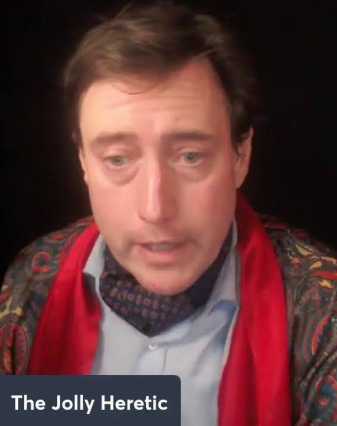
Male GeniusEdward DuttonCommentary by Simon Sheppard
Audio: Newton, Male Genius and Women in AcademiaMost browsers will play this MP3 file, or right-click to save |
|
This excellent talk was extracted from a longer interview Dutton did with a Barbadian (?) gentleman. The latter had an insufferable and sometimes unintelligible voice, but neglecting that, the interview had so much good information that it was deemed worthy of editing and reproducing here.
Among its revelations is that at one point Oxford University decided to admit women, on equal terms, then relented because of its adverse effects. Contrast that with today, when women comprise the majority in our universities. With great precision Dutton describes the origins and consequences of female influence in academia.
An interesting topic raised is hyper-empathy, as should be expected in a super-feminine environment. Often the terms sympathy and empathy are confused, but sympathy involves consideration and caring for others, while being empathetic is the ability to perceive others’ emotional and psychological state. For example, sociopaths* can use their empathic abilities to determine what someone wants to hear, perceiving their unstated motivations and insecurities, then coldly manipulate them using that knowledge. That is empathy without sympathy. Hyper-empathy results in exaggerated or false attribution of motives and intentions to common signals. Just looking at someone can be given all sorts of wild interpretations.
* Confusion also exists, at least in informal use, between sociopath and psychopath. A common-sense distinction can be that even as the sociopath possesses psychopathic traits, he stops short of breaking the law, while the psychopath with his lack of conscience commits crimes to satisfy his ego and secure other benefits.
Dutton’s particular field in psychology seems to be intelligence and he will surely be aware that although average male and female intelligence is similar, male variation is far greater. Also male and female brains are different: the width of the corpus collosum and disparity in the balance of grey and white matter have often been quoted, but I am not up to date on this. In the unedited interview Dutton opined on the weak correlation between homosexuality and intelligence, also religion and black slavery, topics perhaps of special interest to his interviewer. He fell foul of a common failing of academics, that of straying outside their field, in this case making rather too definite pronouncements about schizophrenia which I suspect a psychiatrist would question, or at least seriously qualify.
Another trap into which people can fall is to fit things into the frame of their own particular speciality. Often genius is defined as exceptionally high intelligence. I don’t think this is right: in other words, and to the contrary, there is a less than perfect correlation between exceptional intelligence and genius. A university friend once told me, “The most important thing I’ve learnt at university is how stupid intelligent people can be.” It may be that some aspects of genius can’t be quantified, no matter how hard psychologists try. The best description of a genius I have heard is “Someone who changes our way of looking at the world.”
Of the remainder, I am somewhat doubtful of Dutton’s explanation of the origins of patriarchy, in particular, that males preferentially selecting religious females as mates has been a significant evolutionary influence. For a start, as Darwin said, “It is the female which usually exerts a choice.” Moreover, incredible as it may seem, people really believe the gumph they see on screen and TV featuring some athletic woman single-handedly fighting off three soldiers or whatever. Reality is very different. For the entirety of our phylogeny, until very recently, a man had absolute authority to strike his wife or children if he felt it necessary. This may not have been resorted to very often, but the implicit threat was always there, in accord, I might add, with the natural order of things.
A significant omission is at the end, in discussing the decline in male testosterone levels. Dutton fails to mention the many potential biological origins of this, such as effluent from the contraceptive pill and constant exposure to plastics, to name but two. However the listener is reminded of the profound nature of this hormonal change, undoubtedly having enormous societal effects.
Such matters aside, Dutton has earned my admiration for his erudition and fortitude in exploring these topics. No doubt if his conclusions were in accord with the prevailing feminist narrative he would be favoured with much greater prominence. Originally with filedate 22 Sept. 2024 and 75 minutes long, the talk has been reduced to 25 minutes in ten sections separated by a very brief pause. The sections are as follows:
