 heretical.com
|
THE PRICE OF LOVEEnglish Wife SalesGary Slapper etc. |
Andy Hoyle, 35, from Wrexham was inundated with offers in 2003 after putting his wife up for auction on the internet. He advertised Mel, 30, on eBay with the words “The chassis is in excellent order for the mileage, and warranty given at extra cost.”
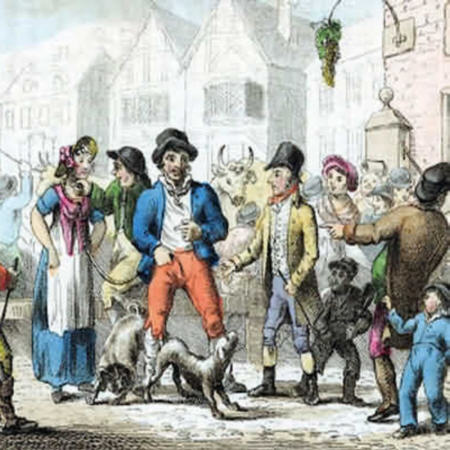
In the centuries before legal divorce was available to most people, the auctioning of wives was a popular way to dissolve broken marriages. Such ‘wife-sales’ were run in market squares from the middle ages until 1887. The sales were not legal (Lord Mansfield regarded them as criminal conspiracies) but were generally tolerated by the authorities. On 18 July 1797, The Times reported the case of a butcher who “exposed his wife to sale in Smithfield Market, near the Ram Inn, with a halter around her neck, and one about her waist which tied her to a railing.” In that case “a hog driver was the happy purchaser, who gave the husband three guineas and a crown for his departed rib.” Such sales, however, depended on the wife’s consent, and the purchasers, who were arranged in advance, were normally the woman’s paramours.
Gary Slapper, Weird Cases: Comic and Bizarre Cases from Courtrooms Around the World, Wildy, Simmonds & Hill Publishing (2010), p. 35.
Until the Marriage Act of 1753, there was no requirement for a formal marriage ceremony performed by a clergyman. There was no official licence or registration. Providing both parties were of legal age, marriage was just by mutual agreement. The legal age for marriage at that time was 14 for boys and 12 for girls.
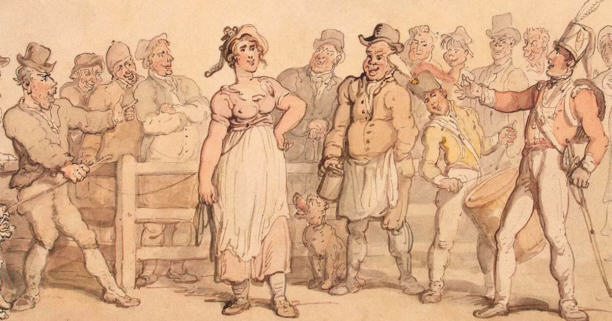
In one of the last reported instances of a wife sale in England, a woman giving evidence in a Leeds police court in 1913 claimed that she had been sold to one of her husband’s workmates for £1.
Historical records, primarily newspaper accounts preserved from the period, document approximately 222 to 400 instances between 1735 and 1899, with peak activity during the Industrial Revolution when social mobility and economic pressures exacerbated marital strains among laborers and farmers. Average sale prices hovered around £5.72 in constant 1800 pounds, reflecting the transaction’s role in compensating the seller for lost “property” rights under coverture doctrine while enabling the buyer to establish a new union without bigamy prosecution. The custom’s defining characteristics included its public nature, which deterred fraud through community oversight, and its adaptation to pre-modern constraints where women lacked independent property or exit options from inefficient marriages. Notable cases, such as a 1796 Sheffield sale for sixpence or a 1826 Brighton auction including a child, illustrate its variability but underscore a consistent aim: efficient marital dissolution via market signals rather than protracted litigation.
References:
