 heretical.com
|
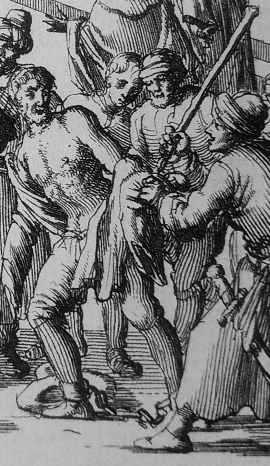
A white slave being sold at market |
Slave Markets and RansomsGiles MiltonExcerpts from White Gold: The Extraordinary Story of Thomas Pellow and North Africa’s One Million European Slaves
|
In 1646, a merchant named Edmund Cason was sent by Parliament to Algiers to buy back as many English slaves as possible. An initial search located some 750, while many more were said to ‘be turned Turkes through beatings and hard usage.’ Cason bargained long and hard, but was obliged to pay an average price of £38 per slave. Female captives proved a great deal more expensive to redeem. He paid £800 for Sarah Ripley of London, and £1,100 for Alice Hayes of Edinburgh, while Mary Bruster of Youghal cost a staggering £1,392 – more than thirty-six times the average. These were huge sums of money; the average annual income of a London shopkeeper was just £10, while even wealthy merchants were lucky to make more than £40 in a year. The cost of ransoming each female slave was more than most Londoners would earn in a lifetime. It helps to explain why the Barbary corsairs were more interested in ships’ crews than in their cargoes.
Cason’s funds were soon exhausted, and he returned to England with just 244 freed captives. Those left behind in Algiers feared they had been abandoned to their fate and sent anguished letters to their loved ones. ‘Ah! Father, brother, friends, and acquaintance,’ wrote Thomas Sweet, ‘use some speedy means for our redemption.’ He begged that ‘our sighs will come to your ears and move pity and compassion,’ and he ended his letter with a plea: ‘Deny us not your prayers, if you can do nothing else.’
The Barbary corsairs had by now extended their attacks across the whole of Europe, targeting ships from as far afield as Norway and Newfoundland. The Portuguese and French suffered numerous hit-and-run raids on their shores and their shipping. The Italian city states, too, were repeatedly attacked, with the coasts of Calabria, Naples and Tuscany enduring particularly aggressive strikes. Russians and Greeks were also enslaved, along with noblemen and merchants from various parts of the Holy Roman Empire. The islands of Majorca, Sicily, Sardinia and Corsica yielded particularly rich harvests for the slave dealers, while the citizens of Gibraltar were singled out so often that wrote a desperate petition to the king of Spain, in which they bemoaned the fact that they never felt safe, ‘neither at night, nor during the day, neither in bed, not at mealtimes, neither in the fields, nor in our homes.’
Spain itself suffered the most devastating raids of all, and entire villages on the Atlantic coast were sold into slavery. The situation was even more critical on Spain’s Mediterranean coast. When the town of Calpe was attacked in 1637, the corsairs made off with no fewer than 315 women and children. Life in Spanish coastal villages soon became so dangerous that new taxes had to be levied on fish, meat, cattle and silk in order to pay for constructing sea defences. But these proved of little use. By 1667, one of the Basque provinces had lost so many seamen to the corsairs that it could no longer meet its quota for the royal levy of mariners.
The Barbary corsairs were indiscriminate when it came to choosing their victims, seizing even merchants and mariners from the colonies of North America. In 1645, a fourteen-gun ship from Massachusetts was the first colonial American vessel to be attacked by an Islamic pirate vessel. The crew managed to fight off this assault, but many of their seafaring comrades were not so fortunate. By the 1660s, a steady trickle of Americans found themselves captured and enslaved in North Africa. The corsairs scored their greatest coup when they captured Seth Southwell, King Charles II’s newly appointed governor of Carolina. It was fortuitous for the king that one of his admirals had recently detained two influential Islamic corsairs, who were released in exchange for Southwell.
The Sallee Rovers continued to plunder English shipping, in spite of the treaties they had signed. By the second half of the seventeenth century, the West Country fishermen were at the wits’ end. Virtually every coastal port had been touched in some way by the white slave trade, and there seemed no hope of ending the crisis. (pp. 27-29)
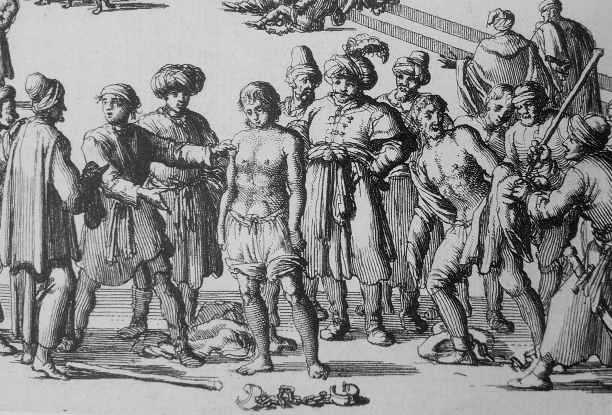
Salé’s slave market had traditionally been the largest and most profitable on Morocco’s Atlantic coast. Like its counterparts in Algiers, Tunis and Tripoli, it did a brisk trade in European slaves, many of whom were pounced on by dealers and later sold elsewhere. In each of the auctions, the overriding goal of the corsairs was to make as much money as possible out of their miserable captives. The finest men and the most beautiful women were eagerly snapped up by private buyers. The old and the sick, who were almost valueless, were sold for a pittance and spent the few months that they survived doing hard labour.
Salé had two slave markets, one on the north bank of the river – now the town’s principal souk – and one on the south. Of the latter market, which was held in the shadow of the magnificent Oudaia Gate, not a trace remains. A gnarled tree spreads shade over the broken ground where slaves once stood in chains, and whitewashed koubba, or domed sanctuary, marks the shrine of a hold marabout. It required a leap of imagination to picture the scene as it was some three centuries ago.
Testimonies of slaves held throughout North Africa reveal a trade that was brutal and devoid of any moral scruples. In the days that preceded the auction, the strongest men often found themselves being treated to unusually generous rations. Abraham Browne was fed ‘fresh vitteles once a daye and sometimes twice in abondance, with good white breade from the market place.’ He rightly suspected that the bread was ‘to feed us up for the markett, [so] that wee might be in some good plight agaynst the day wee weare to be sold.’ As the sun rose on the day of the auction, the slaves were released from their dungeons and taken to the market place. ‘We were driven like beasts thither and exposed to sale,’ wrote William Okeley, who was auctioned at Algiers. ‘Their cruelty is great, but their covetousness exceeds their cruelty.’
Just a few days earlier, these men had been masters of their own destinies. Now, they were stripped and put through their paces. ‘They were made to jump and skip to test their agility; they had foreign fingers poked into mouths and ears. The experience of being auctioned was both terrifying and humiliating, and every individual had his own tale of suffering. George Elliot had been distressed by the way in which he was jostled through the crowd of dealers. He was chained to a black slave-driver, who ‘coursed me up and down, from one person to another.’ Joseph Pitts was appalled to discover that the dealers in Algiers had a sales patter that as similar to that of the traders peddling onions and aubergines in the weekly vegetable market. ‘“Behold what a strong man this is! What limbs he has! He is fit for any work. And see what a pretty boy this is! No doubt his parents are very rich and able to redeem him with a great ransom.”’
Most of the slave dealers were keen to examine the teeth of their captives. ‘Their first policy is to look in their mouths,’ wrote Okeley, ‘and a good, strong set of grinders will advance the price considerably.’ There was a clear, if disturbing, logic to their interest in teeth: ‘they [know] that they who have not teeth cannot eat; and that they that cannot eat, cannot work; and they that cannot work, are not for their turn; and they that are for their turn, are not for their money.’
Once the slave dealer had satisfied himself that the slave in good physical shape, he would make an offer. Prices varied enormously and were largely dependent upon the age and fitness of the slave. But family background also played a role, for many dealers bought slaves in the hope that they came from a rich family and could be ransomed for a large sum. Browne records that the common seamen on board his ship changed hands for between £30 and £35, while the two boys ‘weare sold for £40 apice.’ Browne himself was judged to be worth a mere £15 – ‘a very low rate’ – although that price rose dramatically during the course of the slave auction. ‘Some Jews rise me up to 75£,’ he wrote, ‘which was the price my paterone [owner] gave for mee.’
Captain Pellow and his men feared much the same fate, for they were all too familiar with stories of slaves being bought and sold in Barbary. In the years prior to the capture of the Francis, there had been a flurry of publications written by escaped slaves, and many had enjoyed a wide circulation. William Okeley, Thomas Phelps and Joseph Pitts had all published long and fascinating accounts of their years in slavery, while many other stories circulated in the dockside taverns of the West Country. What the newly captured men probably did not realise was that the great slave market at Salé had become a thing of the past. While the auctions remained a regular fixture in Algiers, Tunis and Tripoli, the Salé market had undergone great changes since Moulay Ismail had acceded to the throne. One of his first acts had been to close the market – not out of charity, or human kindness, but because he wished to keep all the slaves for himself. All recently seized men, women and children were taken from Salé to Meknes, where they were presented with all due pomp to their new owner, the sultan of Morocco. (pp. 68-71)
White Gold: The Extraordinary Story of Thomas Pellow and North Africa’s One Million European Slaves, Hodder & Stoughton, London, 2004.
