 heretical.com
|
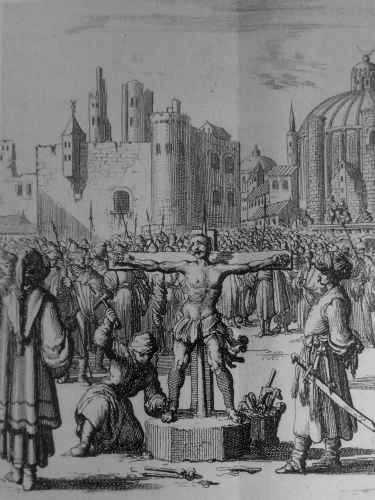
Slaves were treated with great cruelty and public executions were commonplace |
Religion in SlaveryGiles MiltonExcerpts from White Gold: The Extraordinary Story of Thomas Pellow and North Africa’s One Million European Slaves
|
[John] Harrison [emissary from Charles I seeking the release of British slaves] could have been forgiven for a failure of nerve on his arrival at the great walls of Salé, whose array of bronze cannon gave a hint of the menacing threat within. His orders were to penetrate the inner sanctum of this nest of corsairs, who held all Christians in the utmost contempt. Their spiritual leader was Sidi Mohammed el-Ayyachi, a wily marabout, or holy man, who was revered by the Salé slave traders. Pious and politically adroit, he had a personal magnetism that inspired fanatical loyalty. He was particularly revered for his hatred of Christianity and would later brag of having caused the deaths of more than 7,600 Christians. (p. 18)
There were very few captives who avoided a bastinading. The ankles of the condemned slave were strapped together with rope, and he was suspended upside down so that his neck and shoulders were just resting on the ground. ‘Then comes another lusty, sturdy knave,’ wrote William Okeley, a British captive in Algiers, ‘and gives him as many violent blows on the soles of the feet as the council shall order.’ Slaves elsewhere in North Africa were accustomed to receive forty or fifty blows; in Morocco, they were often given many more. On one occasion, Moulay Ismail ordered two slaves to be given 500 bastinadoes each. ‘[This] put the hip of one of them out,’ wrote Father Busnot, who was a witness to the event, ‘but it was set again some time after by the violent operation of a second bastinado.’
Pellow’s beatings were brutal affairs. They were personally administered by Moulay es-Sfa, who took delight in thrashing him senseless. He work work himself into a terrible rage, ‘furiously screaming in the Moorish language, “Shehed, shehed! Cunmoora. Cunmoora! In English, Turn Moor! Turn Moor,” by holding your finger.’ This simple signal – raising one finger to the sky – was all that was required by Christian slaves to show that they agreed to apostatise. To many Muslims, it was a signal that they denied the Holy Trinity. (p. 81)
This was something that the Algiers slave, Joseph Pitts, had discovered to his cost. ‘You must know,’ he wrote, ‘that when a Christian slave turns Mohammetan, there can be no ransom for him.’ Nor was he likely to be set free by his owner, as many converts wrongly assumed. ‘’Tis an error among some,’ continued Pitts, ‘... that as soon as ever a Christian turns Turk, he [thinks he will be] emancipated or become free.’ He said it was extremely rare for slave converts to be released. ‘I have known some that have continued slaves many years after they have turned Turks,’ he wrote, ‘nay some, even to their dying day.’ Very few were treated with any respect after converting to Islam; Pitts cited his own case an an example and warning. ‘[I] suffered a great deal of cruel usage,’ he wrote, ‘and was then sold again.’
It was nevertheless common for slave converts to be accorded much pageantry on the day of their apostasy. Germain Mouette describes how in Morocco they were ‘Walk’d about the town on horseback in triumphant manner, with the noise of drums and trumpets.’ In Algiers, and elsewhere in North Africa, such ceremonies were even more extravagant. The new convert was given splendid new clothes and loaned a finely caparisoned horse. ‘He is also richly habited and hath a turbant on his head,’ wrote Pitts.
He was then marched around the city accompanied by stewards and sergeants. These held ‘naked swords in their hands, intimating thereby... that if he [the convert] should repent, and show the least inclination of retracting what he had declared... he deserved to be cut in pieces.’ Some slave converts reported having to perform a humiliating renunciation of Christianity before the ceremonies were over. They were made to ‘throw a dart to the picture of Jesus Christ in token of disowning him as the saviour of the world.’
Thomas Pellow’s apostasy had been made under duress, depriving him of any right to such pageantry. The only tangible sign that he had converted was his enforced circumcision, a humiliating and painful operation that was often performed in public. Father Pierre Dan was the first to write about such surgery – more than eighty years earlier – informing his readers that in Algiers the surgeon ‘cuts the foreskin of the unfortunate renegade in the presence of everyone.’ He added that unlike the Jews, who ‘only cut a little bit of the skin of the foreskin,’ the Barbary Muslims were prone to ‘cut it entirely, which is extremely painful.’
The operation was usually a botched affair and a cause of such loss of blood that the convert was obliged to take to his bed for several weeks. Only when fully recovered did he get to enjoy the Muslim slave woman he was invariably given as a wife.
Moulay el-Sfa continued to beat Thomas Pellow as he was recovering from his circumcision, in punishment for his refusal to wear Moroccan dress. ‘I was kept forty days longer in prison,’ wrote Pellow, ‘on my refusing to put on the Moorish habit.’ When fresh beatings opened old sores, he decided that his ‘very foolish obstinacy’ was futile. ‘Rather than undergo fresh torments, I also complied with it [the dress], appearing like a Mahometan.’ His head was shaved, his old clothes were taken away and he was given a long woollen djellaba. (pp. 82-84)
The slaves were terrified of the sultan’s whimsies – just as he intended – for they never knew who would be his next victim. The British and colonial American captives wrote little about how they found the inner strength to survive the daily horror of life in the slave pens. But when the Boston preacher, Cotton Mather, met a group of American slaves released from Algiers in 1681, they told him that communal prayer had done much to fortify their spirits. ‘[They] formed themselves into a society,’ he wrote, ‘and, in their slavery, enjoyed the liberty to meet on the Lord’s Day evening.’ The men warned each other about the temptation of apostasy and even set out a code of conduct ‘to prevent and suppress disorders among themselves.’ Many of the slaves from the American colonies were deeply religious men, having been raised in strict Puritan households. Joshua Gee, a puritan from Boston, Massachusetts, admitted that prayer alone had enabled him to survive his suffering. ‘I always found reliefe in seeking God, when I could find it nowhere else,’ he wrote. ‘It was a great relief to me that I had learned so much scripture by heart when I was young.’
The British slaves in Meknes also found strength in prayer. According to Francis Brooks, they prayed ‘for the preservation of their own king and country, and that God would be pleased to open their hearts to remember them in this sad and deplorable condition.’ They prayed for their families; they prayed for their comrades. But most of all, they prayed to be released from the appalling hardship and suffering.
These Protestant captives always looked with envy upon their Catholic counterparts. Moulay Ismail permitted his Catholic slaves a certain freedom of worship – as did the dey of Algiers and the bey of Tunis – and occasionally allowed the padres in the friary to celebrate religious festivals. The most colourful of these was the feast of Corpus Christi, when the padres would bribe the slave guards to allow all the Catholic slaves to participate. In the spring of 1719, Father Francisco Silvestre was one of those who helped organise the festival. ‘On this day,’ he wrote, ‘the walls of the patio of the sagena [slave pens], where the procession begins, are decorated with green stalks.’ Arches were bedecked with herbs and flowers, and all the slaves were given candles. ‘A cleric leads... [and] all walk, chanting hymns appropriate to the day.’ It was one of the few times in the year when the Catholic slaves could momentarily forget the miseries of their lives.
Moulay Ismail did not always allow the padres to celebrate such festivals. He gave 500 bastinadoes to one slave who asked if the men could celebrate the feast of St John the Baptist and showed even less inclination to offer concessions to his British and American captives. ‘Some of them had asked him leave to keep their Easter,’ wrote Father Busnot, ‘as he had granted it ten days before to the French Catholick slaves.’ The sultan pondered for a moment, then asked if they had fasted. When they shook their heads, he told them: ‘Where there is... no lent, there is no Easter, and so he sent them back to the works.’ It was a typically cruel but rational observation. (pp. 133-135)
A fervent follower of Koranic teaching, Moulay Ismail was careful to display his religious orthodoxy whenever he was seen in public. ‘He causes the Koran to be always carried before him by his talbe [religious scholars] as the rule for all his actions,’ wrote Father Busnot. ‘Wheresoever he is, he often lifts up his hands to heaven, and that very often when they are imbr’d with human blood.’ The sultan ordered the construction of prayer places throughout his palace and often preached in the mosques, ‘after such a manner ... that he outdoes all the talbe.’ He constantly reminded his courtiers that he was descended from the prophet and that his every word and deed was sanctified by God.
Such fanatical devotion to Islam was greatly admired in Morocco, but it was the source of growing consternation in the Christian West. ‘It curbs none of his passions and justifies all his enormities,’ wrote Father Busnot, ‘...[and] sanctifies the cruelties he exercises towards the Christians and Moors.’ In the eyes of Busnot and many other Europeans, Moulay Ismail had co-opted religion for his own, diabolical ends. (p. 156)
Fear of Islam was a subject of equally heated debate in the crown colonies of North America – especially New England, which had lost a number of merchants and mariners to the Barbary corsairs. One of Boston’s Puritan ministers, Cotton Mather, was particularly taxed by the issue of apostasy. He conceded that the slaves were suffering terrible deprivations in Morocco, yet believed that the physical hardship was no excuse for spiritual weakness, rather that it should help the slaves to strengthen their Christian faith.
In 1698 – the year after the publication of Prideaux’s book – Mather wrote ‘A Pastoral Letter to the English Captives in Africa.’ His tone was uncompromising, and he had few words of comfort for these bruised and battered men. ‘Who gave you to the African pyrats?’ he asked sternly. ‘It was the Lord, against who you had sinned.’ He insisted that their own faithlessness had led to their capture and reminded them that there was very little their friends could do to win their release. ‘You cannot now make your moans to your consorts, to your parents, to your tender-hearted relations... but you must make your moans to God in the Lord Jesus Christ.’ (p. 165)
The erratic behaviour of Sultan Moulay Ismail dissuaded any Spanish padres from sending an embassy to Morocco, recognising that as they stood so little chance of buying back any captive Spaniards, the men would have to be abandoned to their fate. The redemptionist fathers decided instead to sail to Tunis and Algiers, where the slave population still numbered around 25,000. In three missions between 1722 and 1725, Father Garcia Navarra managed to release 1,078 slaves, although he was infuriated by the dey’s insistence that he buy both Catholics and Protestants. When the Spanish padre curtly remarked that the latter were heretics and therefore undesirable, the dey exploded with rage. ‘What I want, the Lord God wants,’ he fumed, ‘and the king of Spain had better want it too.’ (p. 222)
White Gold: The Extraordinary Story of Thomas Pellow and North Africa’s One Million European Slaves, Hodder & Stoughton, London, 2004.
