 heretical.com
|
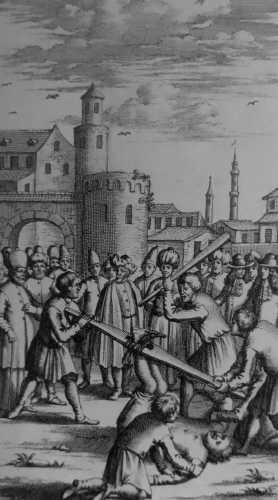
Hardly any slave escaped the bastinado |
Palaces, Harems, First WifeGiles MiltonExcerpts from White Gold: The Extraordinary Story of Thomas Pellow and North Africa’s One Million European Slaves
|
The imperial palace at Meknes was the largest building in the northern hemisphere. Its crenelated battlements stretched for mile upon mile, enclosing hills and meadows, orchards and pleasure gardens, its sun-baked bulwarks looming high over the river valley. The impregnable fortress was designed to withstand the mightiest army on earth. Each of its gates was protected by a crack division of the black imperial guard.
The sultan’s palace was constructed on such a grand scale that it came to be known simply as Dar Kbira, The Big. Yet Dar Kbira was just one part of a huge complex. A further fifty palaces, all interconnecting, housed the sultan’s 2,000 concubines. There were mosques and minarets, courtyards and pavilions. The palace stables were the size of large town; the barracks housed more than 10,000 foot soldiers. (pp. 3-4)
Every hand-glazed mosaic in the monumental palace... had been built and crafted by an army of Christian slaves. Flogged by black slave-drivers and held in filthy slave pens, these abject captives were forced to work on what the sultan intended to be the largest construction project in the known world. Moulay Ismail’s male slaves were said to have toiled for fifteen hours a day and were often forced to work at night as well. The female captives were even more miserable. Dragged to the harem and forcibly converted to Islam, they had the dubious honour of indulging the sultan’s sexual whims.
Morocco was not the only place in North Africa where white captives were held as slaves. Algiers, Tunis and Tripoli also had thriving slave auctions, in which thousands of captives were put through their paces before being sold to the highest bidder. These wretched men, women and children came from right across Europe – from as far afield as Iceland and Greece, Sweden and Spain. Many had been seized at sea by the infamous Barbary corsairs. Many more had been snatched from their homes in surprise raids. (p. 6)
The number of women in Moulay Ismail’s several harems was a constant source of fascination for European visitors to the imperial palace. Pellow claims that the sultan had more than 4,000 concubines during the time he was in Meknes, all of whom were ‘closely shut up in other houses allotted for them.’ Such a number is impossible to verify, although Moulay Ismail is known to have sired a vast number of children. The birth of each child was marked by a special tax upon the country’s Jews, in order that suitable gifts could be bought. The register of this tax suggests that the sultan had at least 1,200 children during the course of his long reign.
Pellow never glimpsed inside the harem, for to do so would have cost him his life. But a Dutch slave girl named Maria Ter Meetelen left a unique portrait of life in the quarter that Pellow was now set to guard. ‘I found myself in front of the sultan,’ she wrote, ‘in his room, where he was lying with at least fifty women.’ They were ‘painted on their faces and clothed like goddesses, extraordinarily beautiful, and each with her instrument.’ Maria listened in amazement as ‘they played and sang, for it was a melody more lovely than anything I’d ever heard before.’
The ladies of the harem presented an extraordinarily rich spectacle. The sultan’s principal wives were decked in gold drops and pearls, ‘which were hanging from their necks and were very heavy.’ They wore golden crowns interlaced with more pearls, and their wrists jangled with gold and silver bangles. Even their hair was pleated with golden thread, which sparkled in the brilliant sunlight, while their necklaces were so laden with gems ‘that I was wondering how they keep their heads straight with all that gold, pearls and precious stones.’
The sultan’s concubines spent the greater part of their lives shut away from the outside world and rarely left this forbidden corner of the palace. Many grew so bored with life in the harem that they bribed their eunuchs into acquiring wine from the Christian slaves. Others sneaked out to visit friends elsewhere in the palace. Such clandestine sorties were made with great risk. When Father Busnot was in Meknes, he said that Moulay Ismail ‘caus’d fourteen of them to have all their teeth drawn for having visited one another privately.’
The sultan’s harem often contained European slave girls who had been captured at sea by the Salé corsairs. Francis Brooks had watched the arrival of four English women seized aboard a vessel bound for Barbados. The chief eunuch informed the sultan that there was ‘a Christian virgin amongst the rest of the women,’ and a delighted Moulay Ismail urged her to renounce her faith, ‘tempting her with promises of great rewards if she would turn Moor and lie with him.’ The girl refused to apostatise, earning herself the full force of the sultan’s wrath. ‘[He] caused her to be stript, and whipt by his eunuchs with small cords, so long till she lay for dead.’ He then instructed his black women to take her away and feed her nothing but rotten bread. The poor girl’s spirit was eventually so broken that she had no option but to ‘resign her body to him, tho her heart was otherwise inclined.’ The sultan, gratified, ‘had her wash’d and clothed... and lay with her.’ Once his desire was sated, ‘he inhumanly, in great haste, forc’d her away out of his presence.’ The love-making was perfunctory but productive. The girl became pregnant and eventually gave birth to a healthy child who was destined to a life of servitude in the great palace of Meknes. (pp. 120-121)
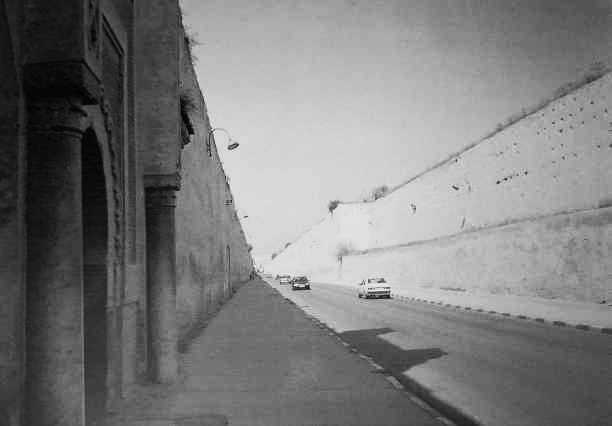
This long alley, flanked by palace walls, is where Moulay Ismail liked to ride in his chariot; it was drawn by his wives and eunuchs.
One of the few checks on Moulay Ismail’s rule came from a most unexpected quarter. The sultan’s first wife, Lala Zidana, exercised considerable authority over him and was adept at imposing her will. She was, by all accounts, a veritable harridan, ‘black, and of a monstrous height and bulk,’ wrote Father Busnot in 1714. She had beady eyes and an elephantine belly, and had once been a slave of the sultan’s brother, who had sold her to Moulay Ismail for sixty ducats. Quite why he was so infatuated with her remains a mystery. There were many at court who believed her to be a witch who retained the affections of the sultan by means of spells and incantations. She ruled the harem with great ruthlessness and – in common with Madame de Pompadour at Versailles – she ensured that her lover was supplied with a stream of young virgins. But unlike her French counterpart, Zidana had neither grace nor charm. ‘When she goes abroad,’ wrote Simon Ockley, ‘she wears a sword by her side, and a lance in her hand; and is as cruel and imperious as the king himself.’
Zidana held sway over Moulay Ismail with machiavellian adroitness. She ensured that her first-born son, Zidan, was named as the sultan’s heir, and she retained tight control over the harem. Her chief rival for the sultan’s affections could not have been more different – a wistful young girl who had been brought to the harem as a Christian slave. Either Georgian or English, this apostate virgin soon bore Moulay Ismail a son, Moulay Mohammed. Fearful that her own position was under threat, Zidana turned on the girl with chilling aplomb. She falsely informed the sultan that his young sweetheart had been unfaithful and bribed witnesses to testify against her. The sultan was so incensed that he had the girl summarily strangled.
Zidana oversaw the murder of countless other rivals, including that of Moulay Mohammed. She also had a hand in the grisly execution of one of the sultan’s kaids, who was ordered to be sawn in two. Even the sawyers were revolted, for they were told to start sawing between the thighs, rather than at the head, as was customary. ‘[They] were all bloody,’ wrote Father Busnot, ‘[and] stood sometimes void of sense and motion, and the teeth of their saw tore off pieces of flesh, that none could endure to look at.’ (pp. 152-153)
John Windus tried to take stock of all he had seen. He calculated that the main living quarters of Moulay Ismail and his wives were ‘about four miles in circumference’ and stood on the highest ground. The external walls were built of mortar that was ‘in every part very thick.’ Windus reckoned that each section of wall – there were too many to count – was approximately one mile long and twenty-five feet thick, enclosing many ‘oblong squares a great deal bigger than Lincoln’s Inn Fields,’ some of which were entirely decorated in mosaic tiling. Several contained sunken gardens of astonishing depth and were planted with ‘tall cypress trees, the tops of which, appearing above the rails, make a beautiful prospect of palace and garden.’
Beyond the private quarters of the palace lay the ongoing building works of the Madinat el-Riyad – home to Moulay Ismail’s viziers and courtiers, as well as his black guard, horses and huge stockpiles of grain. Although Windus tried to work out the total area of ground enclosed by the palace, he found it impossible since entire sections were continually being remodelled or enlarged by the sultan. He nevertheless calculated that if the various buildings were lined up, one next to the other, they would ‘by a moderate computation’ stretch from Meknes to Fez – a distance of some forty miles.
His incredulity at the scale of the palace was tempered by the fact that it had been built entirely by Christian slave labour, aided by bands of Moroccan criminals. ‘It is reported that 30,000 men and 10,000 mules were employed every day in the building of the palace,’ wrote Windus. He added that such figures were ‘not at all improbable, seeing that it is built of hardly anything else but lime, and every wall worked with excessive labour.’ (p. 189)
White Gold: The Extraordinary Story of Thomas Pellow and North Africa’s One Million European Slaves, Hodder & Stoughton, London, 2004.
