 heretical.com
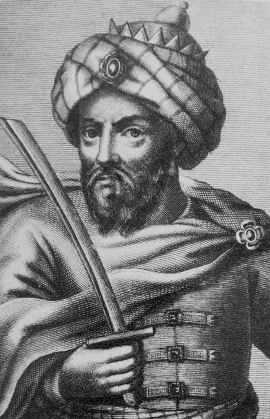
|
Moulay Ismail |
Moulay IsmailGiles MiltonExcerpts from White Gold: The Extraordinary Story of Thomas Pellow and North Africa’s One Million European Slaves
|
For centuries, Moulay Ismail’s family ruled the Tafilalt with carefree indolence, stirring from their torpor only to murder a rival or despatch an interloper. Their power did not extend beyond the palm-fringed oases of the desert, and there was little sign that they were about to thrust themselves into the imperial pleasure palaces of Fez and Marrakesh. Yet they were a family with noble roots and an illustrious pedigree. One of their forbears, al-Hasan bin Kasem, was a sharif – a descendant of the Prophet Mohammed. This imbued them with a sacred piety, which Moulay Ismail would later exploit with aplomb.
Many of Morocco’s bandit rulers could command small armies of European slaves and renegades, and Ismail’s family were no exception. Moulay Ismail himself had been given his first slave when he was just three years of age. Dom Louis Gonsalez was a Portuguese cavalry officer who had been ambushed and captured while serving in the garrison of Tangier, at that time held by Portugal. Dom Louis soon found himself playing father to the toddler: ‘he had him continually in his arms,’ wrote one, ‘and gradually won the affection of the little prince.’ In later years, Moulay Ismail ‘would always have him in attendance’ and would eventually free Dom Louis after he had served more than thirty years in captivity. He was one of the few slaves who would ever escape his grasp.
The clan into which Ismail was born had become unruly and quarrelsome, and their hands were steeped in fratricidal blood. In 1664, Moulay Ismail’s brother, Moulay al-Rashid, had wrested the family lands from a rival sibling, murdering him in the process. After installing himself as ruler of the Tafilalt, he led his army north towards the Rif and added this mountainous domain to his fiefdom.
Soon after, he captured the populous city of Fez and tortured its governors with such enthusiasm that the terrified townsfolk of nearby Meknes immediately capitulated. Moulay al-Rashid, feeling that his hour had arrived, promptly declared himself sultan of all Morocco and installed his young brother, Ismail, as governor of Meknes and viceroy of Fez. In the space of two bloodstained years, the family’s fortunes had been transformed.
Moulay al-Rashid had gained his kingdom through terror, and he vowed to rule by terror as well. Germain Mouette, who witnessed him in power, was appalled by his unstable temperament. ‘If I were to undertake the narration of all the cruelties and massacres he has committed,’ he wrote, ‘of all the human blood he has shed for trifling faults... the story would make a great volume.’ Rashid hoped to extend his frontiers even farther and acquired bands of European slaves to fight his battles. These unfortunate captives proved invaluable in his struggle to pacify the land, many were expert gunners who were able to reduce mud-walled kasbahs to dust with a few well-placed cannon-balls. Moulay al-Rashid’s victorious army swept southwards to the pink-walled city of Marrakesh, which was captured after a token resistance. The sultan was so ‘inflated with prosperity’ that he began to plan the conquest of the southern Sahara. But before this could be achieved, his life was cut short amidst the lemon groves of his Marrakesh palace.
The weary European slaves welcomed his death, hoping that the constant battles would at long last come to an end. So did the sultan’s kaids, or lords, who had been relieved of much of their wealth during his reign of terror. What neither the slaves nor the kaids foresaw was that a far more tyrannous individual was waiting to wrest the reins of power. According to Mouette, ‘it was as if nature, before giving birth to so exceptional a being, had attempted first to sketch the model.’
The news that Moulay Ismail had proclaimed himself sultan infuriated many members of his extended family. One of his brothers, Moulay al-Harrani, also declared himself sultan, as did his nephew, Moulay Ahmed. Other factions rose up in rebellion and attempted to carve out fiefdoms from the rapidly disintegrating empire.
Moulay Ismail’s forces proved more than a match for these fledgling armies, and was encouraged by a number of decisive victories. His military successes – like those of his late brother – were due in part to the services of the European slaves he had managed to capture. ‘Having some Christian slaves which he took from the Jews,’ wrote one of England’s few Islamic scholars, Simon Oakley, ‘that were very skilled in managing his cannon, he soon became formidable to the enemy.’
Moulay Ismail rarely showed magnanimity towards the slaves he captured in battle. When the town of Taroudant fell to his troops, he seized 120 French slaves. Having poked and prodded these miserable captives, he declared them to be overfed and ordered them to be denied rations for a week. Then, when they were crying out for food, he sent them on a long march to Meknes.
One of these slaves, Jean Ladire, would later recount the woeful story of his life to the French padre Dominique Busnot. Ladire had by then spent more than three decades in slavery, yet he still had vivid memories of that dreadful march. It was almost 300 miles from Taroudant to Meknes, and many of the chained and shackled captives were suffering from a debilitating sickness – probably dysentery. Several of them dropped dead of fatigue, and ‘the survivors were oblig’d to carry their heads, cut off by their conductors, for fear they should be accus’d of having sold, or suffer’d them to escape.’ (pp. 31-34)
Although he [Moulay Ismail] was seventy years old when Captain Pellow and his men first met him, he was a strong and energetic as a young antelope. ‘Age does not seem to have lessen’d anything either of his courage, strength or activity,’ noted Busnot just a few years earlier, ‘[and] he vaults upon anything he can lay his hands on.’ He was always keen to show his dexterity with a sword, and the French padre had been as shocked as the British slaves to discover that ‘it is one of his common diversions, at one motion, to mount his horse, draw his cimiter, and cut off the head of the slave who holds his stirrup.’ (p. 78)
The French padre, Nolasque Neant, nevertheless insisted that the sultan had actually expressed the desire to outdo everything that the Sun King [King Louis XIV] had achieved. One European visitor to Moulay Ismail’s court even had the nerve to tell the sultan that if he wished to imitate the king of France, he should not have his subjects and slaves killed in his presence. ‘This is true,’ was the sultan’s ready answer, ‘but King Louis commands men, whereas I command beasts.’ (p. 101)
It was not long before the sultan ordered Pellow to serve as one of his personal attendants. ‘[I was] strictly charged to be observant of the emperor’s commands only,’ he wrote, ‘and to wait on him on all occasions.’ Whenever Moulay Ismail left his palace on horseback in order to inspect the workmanship of his white slaves, Pellow rode alongside. ‘I was generally mounted on the fine horse he gave me for my fidelity in maintaining my post at the door.’ On such occasions, he had to carry ‘a club of about three feet long, of brazil-wood, with which he used, on any slight occasion, to knock his people on the head, as I had several times the pleasure of beholding.’
As Pellow accompanied the sultan on his courtly business, he was obliged to watch in silence as his master lashed out at his slaves. ‘He was of so fickle, cruel and sanguine a nature,’ he wrote, ‘that none could be even for one hour secure of life.’ Pellow watched in despair as Moulay Ismail ordered his black executioners to kill slaves who were slacking, giving them signals to show how he wanted them despatched. ‘When he would have any person’s head cut off,’ wrote Pellow, ‘[he demonstrated] by drawing or shrinking his own as close as he could to his shoulders and then, with a very quick or sudden motion, extending it.’ His sign for a slave to be strangled to death was ‘by the quick turn of his arm-wrist, his eye being fixed on the victims.’ (pp. 124-125)
White Gold: The Extraordinary Story of Thomas Pellow and North Africa’s One Million European Slaves, Hodder & Stoughton, London, 2004.
