 heretical.com
|
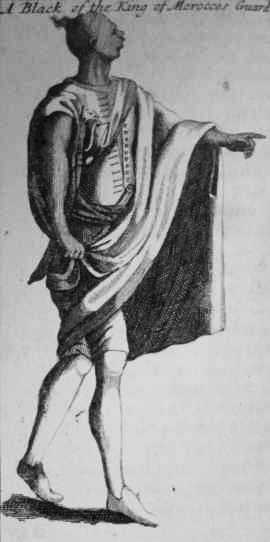
The sultan’s black guards were absolute masters of the European slaves. Reared from childhood in special schools, they were haughty and fiercely loyal to the sultan |
Black OverseersGiles MiltonExcerpts from White Gold: The Extraordinary Story of Thomas Pellow and North Africa’s One Million European Slaves
|
The terrible food was not the only grievance of Captain Pellow and his men. The newly arrived slaves quickly discovered that the black guards appointed to oversee them were extremely violent. The guardian of the British captives lived in a small shack next to the main gate of the slave pen. He was responsible for discipline and punishment, and also kept a daily tally of the captives under his charge. ‘[He] locks them up every night [and] counts them out in the morning,’ wrote John Whitehead. He also woke the men at down and led them to ‘the several drivers or overseers, who carry them to their respective works, where they are kept labouring till the stars appear in the evening.’
The black guards were absolute masters of the slaves under their charge and most had been hand-picked by Moulay Ismail on account of their physical strength and willingness to thrash their captives. Germain Mouette penned a vivid description of his first meeting with the guardian of the French slaves, whose self-appointed role was to make the men’s lives as miserable as possible. A ‘black of prodigious tall stature, of a frightful aspect, and a voice as dreadful as the barking of Cerebus,’ he was also a harsh disciplinarian and always clutched ‘a staff in his hand, proportionable to his bulk, with which he saluted every one of us, and then led us into the storehouses to chuse pickaxes of an extraordinary weight.’
Mouette’s guard was accustomed to chain the men at night and took a sadistic delight in tormenting the French captives. ‘Nothing was to be heard at night in our prisons but the dismal groans,’ wrote Mouette, ‘occasion’d by the violent pains proceeding from our beating.’ Every dawn, the guard would appear at the door with his staff and call the men to work. ‘His voice put such life into us that the moment we heard him in the morning cry out at the door, “eoua-y-alla-crusion,” that is, “come out quick,” every one of us throng’d to be foremost, for the hindermost always felt the weight of his cudgel.’ (pp. 95-96)
It was clear to Captain Pellow and his men that the building work would continue for as long as Moulay Ismail was alive. The sultan was rarely satisfied with the finished building and would often order his slaves to tear down the entire edifice. ‘The unsettled humour of the king of Morocco renders it [the palace] like unto the scenes in a theatre,’ wrote Father Busnot, ‘which change almost at every act.’ He said that ‘the slaves assur’d me that when a man had been ten years away, he cannot know them again, so great are the alterations that [the] prince is daily making.’ In one four-month period, Moulay Ismail forced his slaves to demolish twelve miles of palace walls and then ordered that the chunks of rubble be ‘beaten to powder.’ Once this work was completed, he told the slaves to rebuild the walls in exactly the same position. When the sultan was asked why he was constantly demolishing his newly constructed buildings, he explained that he viewed his slaves as scheming vermin who needed to be kept occupied. ‘I have a bag full of rats’ he said ‘[and] unless I keep that bag stirring, they would eat their way through.’
The black slave-drivers were extremely cruel to the men under their charge. ‘[They] immediately punish the least stop or inadvertancy,’ wrote Thomas Pellow, ‘and often will not allow the poor creatures time to eat their bread.’ The drivers worked in shifts and, at the end of each shift, would tell their replacement which of the slaves had been slack in their work. The new driver would then raise his cudgel and beat the hapless slaves, ‘which he always took care to bestow on those parts where he thought they would do most hurt.’ Mouette said that most of the slave-drivers would strike at the head, ‘and, when he had broke it, counterfeited the charitable surgeon, applying some unslacked lime to stanch the bleeding.’ If any slave was beaten so badly that he was no longer able to work, the slave-driver ‘had a dreadful way of enabling him, by redoubling the stripes, so that the new ones made him forget the old.’
The slave-drivers often amused themselves by waking the men at night. ‘It frequently happens,’ wrote Pellow, ‘[that] they are hurried away to some filthy work in the night time, with this call in Spanish, “Vamos a travacho cornutos,” i.e. “Out to work, you cuckolds.” The exhausted men were beaten from their beds and obliged to do another few hours of hard labour.
The guard of the French slaves had been known to punish the men by reducing their already scant rations and sometimes ordered them to clean the city’s sewers. ‘[He] made us empty all the privies,’ wrote Mouette,’ and remove all the dunghills in the town, carrying all the filth in wicker baskets, so that it ran through and fell on us.’ After several days of such treatment, the French slaves were in a terrible condition. ‘Our hams [thighs] were all cut with the weight of our chains, and some of them, as well as mine, were a finger deep in the flesh.’
Moulay Ismail visited the construction site on a daily basis. According to Simon Oakley, he was accompanied by three palace servants: ‘one... to carry his tobacco pipe (which has a bowl as big as a child’s head)... another carries his tobacco, and third a brazen vessel of hot water.’ The slaves trembled as this entourage approached, for they knew that anyone considered to be slacking would be given a sound thrashing. ‘His boys carried short brazil[wood] sticks,’ wrote Pellow, ‘knotted cords for whipping, a change of clothes to shift when bloody, and a hatchet.’
Moulay Ismail’s inspections were punctilious and extremely thorough. He would shout orders, proffer advice and suggest new projects to be undertaken. If the work was not proceeding satisfactorily, he had been known to clamber on the walls and start mixing the mortar himself. He could not abide poor craftsmanship and did not hesitate to punish slaves whose work was of an inferior quality. On one occasion, he was inspecting bricks when he discovered that some were very thin. He called for the master mason and, after admonishing the man for his poor work, ordered his black guard to break fifty bricks over the mason’s head. When this was done, the blood-drenched slave was thrown into prison.
On another occasion, the sultan quizzed one of his slaves about the quality of the mortar. When the trembling slave admitted that it was indeed inferior, Moulay Ismail ‘bid him hold his head fare to strike at; having strucken him, he knocked down all the rest with his own hands and broke their heads so miserably that the place was all bloody like a butcher’s stall.’
The Spanish slaves suffered particularly harsh treatment. When one of their number walked past Moulay Ismail without removing his hat, the sultan ‘darted his spear at him.’ It pierced deep into the man’s flesh and caused him considerable pain as he ripped the barbed tip out of his skin. The slave handed the spear back to the sultan, only to have it thrust repeatedly into his stomach.
The most feared punishment was known as ‘tossing.’ The person whom the emperor orders to be punished,’ wrote Pellow, ‘is seized upon by three or four strong negroes who, taking hold of his hams, throw him up with all their strength and, at the same time, turning him round, pitch him down head foremost.’ The black guards who performed this punishment were ‘so dexterous by long use that they can either break his neck the first toss, dislocate his shoulder, or let him fall with less hurt.’ Pellow said that they would continue to toss the slave until the sultan ordered them to stop. (pp. 104-107)
White Gold: The Extraordinary Story of Thomas Pellow and North Africa’s One Million European Slaves, Hodder & Stoughton, London, 2004.
