 heretical.com
|
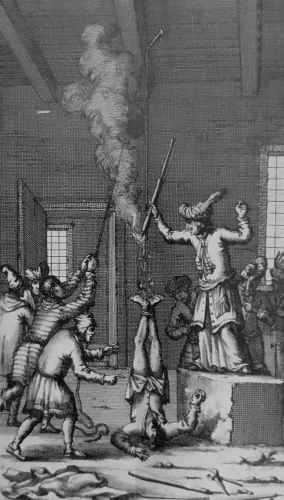
Torture of slaves was commonplace |
Renegades, Turncoats and JewsGiles MiltonExcerpts from White Gold: The Extraordinary Story of Thomas Pellow and North Africa’s One Million European Slaves
|
Thomas Pellow and the other European renegades in Morocco operated in a shadowy world of servitude and slavery. They were rarely subjected to chain gangs and hard labour, yet they were made to work for the regime they despised. The Frenchman, Pidou de St Olon, concluded that although the sultan’s renegades lived apart from the other captives, ‘they were no less his slaves.’ Escape was impossible and freedom remained a dream.
The exact number of renegades forced to serve under Moulay Ismail remains unknown. They rarely figure in the tallies of captives that were compiled by ambassadors and padres. Nor were they considered worthy of being included in negotiations conducted by their home governments. Despised for having forsaken their Christian faith, they were abandoned to their fate.
This was a foolish mistake on the part of Europe’s ministers, for the sultan’s renegades easily outnumbered the captives being held in the slave pens and played a crucial, if unwilling, role in keeping Moulay Ismail in power. Without the services of these apostates – many of whom were desperate to escape – the sultan would have been hard pressed to contain the country’s frequent rebellions. The French consul, Jean-Baptiste Estelle, noted some years earlier that Moulay Ismail’s armoury of 40,000 muskets was in large part cast by renegades, and he added that ‘soon he will more since, in Fez, Christian slaves are casting 400 cannon barrels a month, very fine and of good quality.’
One of the most celebrated of these renegade gun-founders was an Irishman by the name of Carr. A contemporary of Pellow, Carr had been captured as a young lad and voluntarily converted to Islam. ‘The temptation was very great,’ wrote the Englishman, John Braithwaite, who was to meet Carr in the late 1720s. ‘He was offered fine women, and all the riches and grandeur of this country, which if he had not accepted of, he foresaw nothing but slavery, misery and extreme want.’ Moulay Ismail showed unusual respect for Carr on account of his skill at casting weaponry. ‘[He] used to call him brother, and gave him clothes off his back and would hug and caress him very much, and offered him the greatest governments in the country.’ He even made him a kaid and for a short time promoted him to the rank of governor, with control over ‘the frontiers of Guinea.’
Carr was a duplicitous individual whose principal skill was self-preservation. ‘A very handsome man,’ wrote Braithwaite, ‘[and] very ingenious... to us he seemed much to lament his condition and declared himself as much a Christian as ever.’ Years of service in Morocco had left him broken and wretched, and he had frequent recourse to the bottle. ‘He drank with us very hard,’ added Braithwaite, ‘and declared to us if it was not that he locked himself up every now and then and took a hearty dose of wine, he could not have supported his spirits, when he came to think he was for ever lost to his country and friends.’ Carr typified so many of the sultan’s renegades: he was desperate to return home, but knew that the chance of this happening was extremely low.
Few other apostates won the trust of Moulay Ismail. Those who did rise to positions of prominence were quickly corrupted by their now-found power and authority. A Spanish surgeon called Laureano turned against his former comrades after being made the sultan’s personal attendant. He converted to Islam, changed his name to Sidi Achmet and became a most unsavoury individual. ‘His physiognomy is very bad, his heart deceitful, his behaviour brutal and impious, and he is a great enemy to Christians,’ wrote Father Busnot. The most hard-hearted renegades were put in charge of Christian slaves, whom they treated with great contempt. Guilt about their apostasy may have played a part in their brutal behaviour, but they may also have been affected by sights of extreme cruelty. According to one unnamed slave, the worst fate for any European captive was to be ‘belied, back-bitten and beaten by some of their own number who are called Christians.’ These ‘Christians’ – he means apostates – had gained their positions through flattery and deception, informing on former comrades who were slacking at work. They knew that they would only retain their posts ‘on proviso that they shall make the other slaves work so much the harder.’ To this end, they became savage and sadistic, and ‘surpass the very barbarians themselves in cruelty, beating their fellows unmercifully.’ (pp. 145-147)
Some of the bukhari became horsemen – ‘the highest esteem imaginable’ – and were appointed stewards to the country’s greatest kaids. They were also employed as emissaries, ‘to carry the emperor’s letter of thanks to any officer who served him well, or to call him cuckold, spit in his face, give him a box on the ear, strangle, or cut off his head.’
On occasions, select members of the black guard were called upon to carry out political assassinations. Moulay Ismail used one of his bodyguards to kill the richest Jew in Morocco, Joseph Maimaran, whose vast fortune had helped him secure the throne. Maimaran made the mistake of reminding Moulay Ismail of his debt, and the sultan responded by having him murdered. ‘The negro did as he was ordered,’ wrote Francis Brooks, who said that Maimaran was followed while he was out riding. ‘[The assassin] spied his opportunity very diligently, so spurred his horse over him, rode upon him, and trode out his brains.’
Moulay Ismail’s relations with Morocco’s large Jewish community was always ambivalent. The majority he treated with contempt, but a handful of the wealthiest – descendants of Jews expelled from Spain – were accorded senior positions at court. One of them, Moses ben Hattar, became treasurer of the court and played a prominent role in keeping Moulay Ismail in power. Another who found great favour with the sultan was Joseph Maimaran’s son, Abraham. He was appointed comptroller of the imperial household soon after his father’s murder. An ugly man, but a skilful survivor, he amassed a vast fortune and was only too willing to lend money to the sultan. Father Busnot thought he had ‘a very ill presence,’ but conceded that he had ‘a great deal of wit and a long experience.’
Neither of these two courtiers showed any interest in helping the Christian slaves. Father Busnot said that Maimaran was the one member of the imperial household ‘that might do most service to Christians, if his inclination was towards it.’ But Maimaran hated Christians with almost as much passion as the sultan himself and had no desire to improve the lot of the European slaves. Nor did any of Morocco’s other influential Jews. One used to boast that he had amassed as many Christian slaves as Moulay Ismail. When asked what he intended to do with them, he gave a wry grimace and said ‘that he would sacrifice one of them every Friday night until they were all consumed.’
Even the wealthy Jews were not immune to the sultan’s wrath. On one occasion, he summoned a group of them to his palace and began to harangue them in a most unpleasant fashion. ‘You dogs,’ he began, ‘I have called you all hither that you may take the red cap and embrace my law.’ He told them that ‘you have amuzed me above these thirty years with the coming of your messias ... [and] if you do not positively tell me the year and day when he will come, you shall no longer enjoy your goods or lives.’
Genuinely alarmed, the assembled Jews asked for eight days in which to consider their answer. Moulay Ismail granted them this request and sent them out of his presence. When they returned the following week, they coolly informed him that their messiah would appear in thirty years. Moulay Ismail scowled and said they had answered thus in the knowledge that he would be no longer alive. ‘I will deceive you in my turn,’ he said. ‘I will live longer than shall be the requisite to make out your imposture.’ He would probably have had the Jews executed for impertinence had they not had the foresight to present him with a huge sack of gold coins. (pp. 150-152)
White Gold: The Extraordinary Story of Thomas Pellow and North Africa’s One Million European Slaves, Hodder & Stoughton, London, 2004.
