 heretical.com
|
Excerpts fromGamesmanshipStephen Potter |
The prime object of gamesmanship in chess must always be, at whatever sacrifice, to build up your reputation. In our small chess community in Marylebone it would be modesty on my part to deny that I have built up for myself a considerable name without ever actually having won a single game.
Even the best players are sometimes beaten, and that is precisely what happens to me. Yet it is always possible to make it appear that you have lost your game for the game’s sake.
‘Regarded la Dame’ Play
This is done by affecting anxiety over the wiseness of your opponent’s move. An occasional ‘Are you sure you meant that?’ or ‘Your castle won’t like that in six moves’ time’ works wonders.
By arrangement with another gamesman I have made an extraordinary effect on certain of our Marylebone Chess Club Rambles by appearing to engage him in a contest without board. In the middle of a country lane I call out to him ‘P to Q3,’ then a quarter of an hour later he calls back to me ‘Q to QB5’; and so on. ‘Moves,’ of course, can be invented arbitrarily.
JUNIOR MEMBER: I can’t think how you do it.
SELF: Do what?
JUNIOR MEMBER: Play chess without the pieces. Do you have a picture of the board in your brain... or what is it?
SELF: Oh, you mean our little game? I am actually up at the moment. Oh, you mean how do we do it? Oh, I’ve always been able to ‘see’ the board in that way, ever since I can remember.
Potter’s Opening
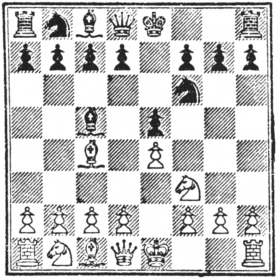
This is supposed, now, to be the name of an effective opening, simple to play and easy to remember, which I have invented for use against a more experienced player who is absolutely certain to win. It consists of making three moves at random and then resigning. The dialogue runs as follows:
|
Potter’s opening
(1) KP-K4 : KP-K4 (2) B-Q B4 : B-Q B4 (3) Kt-B3 : Kt-B3 (4) White resigns |
SELF: Good. Excellent. (Opponent has just made his third move. See above.) I must resign, of course.
OPPONENT: Resign?
SELF: Well... you’re bound to take my Bishop after sixteen moves, unless... unless... And even then I lose my castle three moves later.
OPPONENT. Oh, yes.
SELF: Unless you sacrifice there, which, of course, you wouldn’t.
OPPONENT: No.
SELF: Nice game.
OPPONENT: Yes.
SELF: Pretty situation... very pretty situation. Do you mind if I take a note of it? The Chess News usually publishes any stuff I send them.
It is no exaggeration to say that this gambit, boldly carried out against the expert, heightens the reputation of the gamesman more effectively than the most courageous attempt to fight a losing battle.
Stephen Potter, Gamesmanship, 1947.