 heretical.com
|
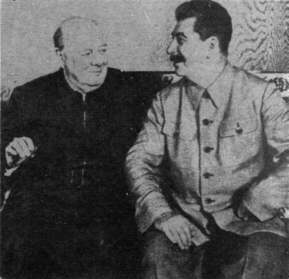
Churchill and Stalin in the Kremlin in August 1942 – or is it just another of Stalin’s “montages” ? The realistic portrayal of Stalin’s withered arm suggests it is authentic |
Winnie and Joe, Bosom Pals |
|
| Churchill’s abhorrence of Bolshevism disappeared as rapidly as his reservations about International Jewry as soon as it suited his personal ambitions |
Winston Churchill was the spoiled son of an aristocratic father and an American mother who doted on him.† As a young man he was a dilettante who developed an early taste for expensive clothes, imported cigars and old brandy. At 26 he entered parliament.
As a politician he continued his dilettante ways, serving in a number of minor posts and switching from one party to another whenever he thought it would further his career. Although he displayed only minimal qualities of statesmanship, his family connections and sharp eye for the main chance led to his steady advancement, and in 1908 he was promoted to the cabinet. When World War I broke out Churchill became First Lord of the Admiralty, effectively the supervisor of the British Navy.
Churchill’s lack of a sense of responsibility and his ineptness as a military strategist led to disaster. He directed the utterly bungled Gallipoli campaign against the Turks in 1915 which led to a total defeat for the British, with more than 100,000 casualties. He was forced to resign his Admiralty post in disgrace.
He returned to his earlier career in journalism and in an article entitled ‘Zionism versus Bolshevism’ which appeared in the Illustrated Sunday Herald of February 8, 1920 he wrote:
‘This movement among the Jews is not new. From the days of Spartacus-Weishaupt to those of Karl Marx, and down to Trotsky (Russia), Bela Kun (Hungary), Rosa Luxembourg (Germany), and Emma Goldman (United States), this world-wide conspiracy for the overthrow of civilisation and for the reconstitution of society on the basis of arrested development, of envious malevolence, and impossible equality, has been steadily growing. It played, as a modern writer, Mrs. Webster, has so ably shown, a definitely recognisable part in the tragedy of the French Revolution. It has been the mainspring of every subversive movement during the Nineteenth Century; and now at last this band of extraordinary personalities from the underworld of the great cities of Europe and America have gripped the Russian people by the hair of their beards and have become practically the undisputed masters of that enormous empire.’
By 1938, when he was 64 years old, Churchill had so lived beyond his means that his creditors prepared to foreclose on him. He was faced with the prospect of the forced sale of his luxurious country estate, Chartwell.
‘At this hour of crisis a dark and mysterious figure entered Churchill’s life: he was Henry Strakosch, a multi-millionaire Jew who had acquired a fortune speculating in South African mining ventures after his family had migrated to that country from eastern Austria. Strakosch stepped forward, advanced the ageing demagogue a “loan” of £150,000 just in time to save his estate from the auctioneer, and then quietly slipped into the background again. In the years that followed, Strakosch served as Churchill’s adviser and confidant but miraculously managed to avoid the spotlight of publicity which thenceforth illuminated Churchill’s again-rising political career.’
† Additional Notes:
‘I have my own theories about Winston’s real origins. These are based on the known facts about both his parents.
‘Known Fact 1: Winston’s mother, Jenny Churchill (née Jacobson) was a notorious adulteress. Jenny Churchill’s promiscuity was so infamous that ZOG Court Historian William Manchester commented on it in detail in Volume 1 of his now to be permanently incomplete Churchill “trilogy,” The Last Lion.
‘Known Fact 2: Winston’s putative father, Lord Randolph Churchill, treated Winston with distance and disdain. The non-existent father-son “relationship” has been the subject of exhaustive micro-analysis.
‘It seems not to have occurred to anyone that Winston may have been a literal as well as figurative bastard.’ Maguire, FAEM (www.faem.com), 9 February 2002
‘Cunning, no doubt, came to Churchill in the Jewish genes transmitted by his mother Lady Randolph Churchill, née Jenny Jacobson/Jerome.’ Moshe Kohn, Jerusalem Post
Prof. Arthur Butz has cast doubt on whether Henry Strakosch was a Jew. Journal of Historical Review, January/February 2002
With acknowledgments to Michael McLaughlin: For Those Who Cannot Speak, Historical Review Press, 1979 and National Vanguard
|
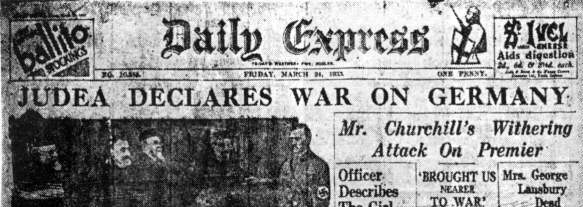
| “Germany is our public enemy No. 1. It is our object to declare war without mercy against her.” Bernat Lecache, President of the World Jewish League, 1932. This came to fruition as shown here, being reported on the front page of the Daily Express on March 24, 1933 |
|
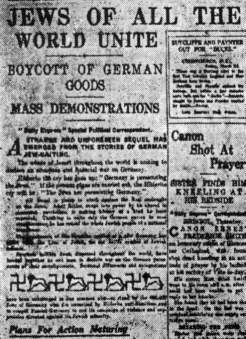
International Jewry declared war against Germany in 1933 simply because the German government had removed Jews from influential positions and transferred power back to the German people. Such declarations of war as carried in the Daily Express were repeated throughout the world.
|
|
| Note: Many newspapers publish two or more editions on the same day. Another version of this front page exists, without the crude photo-montage, which is probably the separately printed Manchester edition. | ||
|
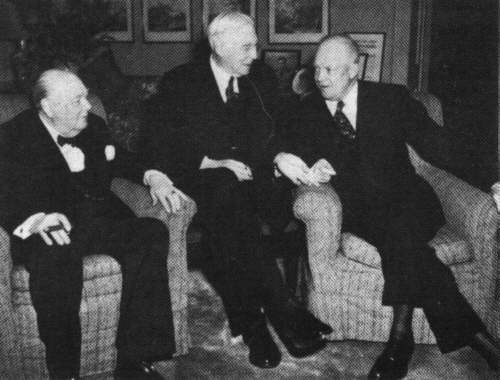
| Winston S. Churchill with his friend, the Jewish financier Bernard Baruch. On the right, the unofficial implementor of the ‘Morgenthau Plan’ and later US President Dwight D. Eisenhower. |
‘I would like to remind you about the kind of system the foreign relations have been taken up with. Here it is:
It was a system that got into power by armed revolt, that dispersed the constituent assembly;
It was a system that liquidated political opponents without any judicial proceedings, that suppressed the strikes of the working men, that pillaged the villages so insufferably thus driving the peasants to rebellions, which were crushed bloodily;
It was a system that destroyed the church, that drove twenty governments of the country into starvation;
It was the system that was first to introduce concentration camps in the twentieth century, as well as the method of taking hostages, i.e. not by catching the persecuted ones, but rather their families or indiscriminately anyone to shoot them down;
It was the system that deceived the working people with all its decrees: the decree concerning the land-reform, the decree concerning peace, the decree concerning the manufacturing plants, the decree concerning the freedom of the press;
It was the system that liquidated all the other parties. I ask you to get me right: It did not alone destroy the parties as such, it did not just dissolve the parties, but it liquidated their members;
It was the system that introduced genocide of the peasantry: 15 million peasants have been deported for liquidation;
It was the system that introduced serfdom anew;
It was the system that provoked an artificial famine in the Ukraine during peace time, 6 million people died of hunger in the Ukraine at the border of Europe during the years 1932 and 1933.
During the years 1918 and 1919 the Tcheka shot more than a thousand people a month without legal procedure. At the climax of the Stalin-terror, during the years 1937-1938, the number of people shot to death averaged more than 40,000 a month. And with this country, with this Soviet Union, the whole allied democratic world entered a war alliance in 1941.’
Alexander Solzhenitsyn in his speech on June 30, 1975 at the Washington Hilton Hotel during an invitation of the US-American Union Organization AFL/CIO

|
| Dresden, pictured above, merely the climax: On 10 May 1940 Winston Churchill came to power and put into motion a new “terror bombing” strategy. The next day, on the 11th, 36 British aircraft bombed the centre of the German city of Munchen-Gladbach in Westphalia. The inspiration behind Churchill was Frederick Lindeman, later Lord Cherwell, a half-American, half-German technical adviser. |
|
‘The historical documents, which condemned millions of people to losing their homes and additional millions to forced labor and death, were signed as a little variety during the breaks between the menu courses in an atmosphere reeking of gravy and generous wines.’ Admiral Leahy, Roosevelt’s Chief Naval Advisor, on the Yalta Conference. Das Ostpreußenblatt, Nov. 5, 1960 p. 3. In Walendy, The Methods of Reeducation. |