 heretical.com
|
|
| Cannibal Culture | |
|
Selected excerpts from Jens Bjerre’s The Last Cannibals on primitive beliefs and customs Australia |
I soon became friends with all the children who hung on my arms in clusters when I walked about. I learned their names and took much trouble to pronounce them properly. Their word for me was djabaldari, which means uncle. When I was given this name I found myself in the peculiar position of acquiring also two ‘fathers’ both of them younger than myself. I shall try to explain how this came about, but I warn the reader that he may find the riddle highly confusing to follow.
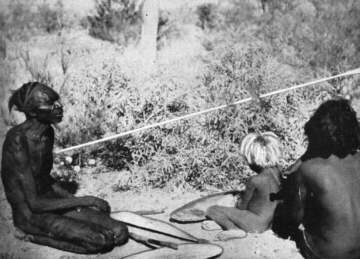
The rituals of the Australian Aborigines are so involved and obscure that scientists who have studied them for many years are confronted with complicated mathematical conundrums; yet when these are at last solved, they turn out to be unexpectedly logical. The basis of the Aborigines’ family system is extraordinary. Before trying to comprehend their patterns of marriage and family relationships, one must exclude from one’s mind our own familiar conception of such relationships which are, of course, based upon consanguinity. The fundamental difference is caused by the fact that the Aborigines do not regard children as simply the result of sexual intercourse, but as spirits appearing yet again in a process of reincarnation. Their communities are not made up in our sense of families related by blood, but by groups and sub-groups formally distinguished by the different ways in which they pronounce the names of the individuals within their groups. The child’s name is given according to the group or subgroup to which its mother and father belong. Its given name, moreover, subsequently determines which members of the group or sub-group are possible marriage partners for the children. The syllables of these basic names are capable of numerous arrangements as elaborate as a complicated game of patience. The child’s name provides, so to speak, the child’s permanent identity disc within the group relationship. When we use the word ‘father’ we mean our actual parental father. The corresponding word in the Aborigines’ language does not, however, signify one man, but several, the others all being members of the group to which the ‘real’ father belongs. All the members of the main group, similarly, are regarded as brothers though they are not related by blood. The son or daughter of any one of them calls them all ‘father.’ It is easy to see how there emerge from this habit such paradoxes as that a man may sometimes be older than one of his ‘fathers.’ Or, similarly, that a child may call his real father, ‘uncle.’ The same principle applies in all other family relationships. The women of a group can, for instance, be called ‘mother’ by a child whose actual mother is one of them. When a man marries, his wife’s mother does not become his mother-in-law merely in virtue of the marriage. The man marries the daughter of a certain woman because that woman, together with other women in her group, is already his future mother-in-law according to the marriage rules. The nearest possible ‘blood’ marriage under this system is between half-cousins. A man can only marry a woman of a certain sub-group of the opposite main group and only if, according to her ‘rating,’ it is her ‘turn’ for his special group. If a man entitled, on this basis, to marry the widow, were to marry her daughter instead, he would be guilty of incest. Again on this basis if a man entitled to marry a certain girl married her widowed mother instead, he, too, would be guilty of incest. The principle whereby each individual in a group is related to all other members of the group creates a unity among them of a most remarkable kind. The primary significance of this system is that each group or family carries prescribed responsibilities. Thus the group as a whole is held responsible for the action of its individual members. From an early age the children are not in the care of their real parents but in the collective custody of the group. For breaches of the law or custom, the whole group, and not the erring individual, is held responsible. If the offence committed is punishable by death, the group does not demand the execution of the real culprit, but is content with the life of any of his group relations.
The Aborigine secures a wife in one of the following three ways: by the distribution of brides on the principle summarized above, or by inheriting a wife of one of his deceased group brothers or, finally, by abduction. The first of these is, of course, the commonest. It proceeds in this fashion. The mother of a small girl decides that she shall be given to a candidate who, according to the pattern of group relationships, has qualified as a son-in-law to the girl’s mother. From this moment of decision, even though she is still only a child, she is looked upon as the man’s fiancée, until, at the age of twelve or fourteen, she is finally transferred to the husband’s keeping. This practice has certain complicated variants. Young newly married girls can arrange beforehand that their own daughters, when they appear, shall eventually marry a certain man within the group who is entitled to the child on the basis of the relationships I have described. A man may thus find himself in the odd situation of not knowing how many wives he will finally get. Moreover, as the man gets older and gains increasing esteem in the group he is usually given more wives by general consent. So that it is, therefore, quite usual for a man of fifty or sixty to find himself with a wife of fourteen or fifteen as well as his older wives.
It might be inferred, from this practice of polygamy, that there are more women than men among the Aborigines. So far as is known there is little difference between the number of boys and girls born, and polygamy is made possible by the fact that the men seldom marry before they are twenty-five, while the women marry as early as twelve. In considering these matters we should remember that the Christian practice of monogamy, itself relatively new in history, was determined very largely by economic and not religious considerations. Polygamy among the Aborigines, as among other primitive peoples, is the result of the environmental condition in which they live. A woman nursing a small child would find it difficult to collect food in the harsh nomadic conditions of desert life, but if, on the other hand, there are several wives living together, one of them can look after all the children, while the others go out in search of food. Again, a younger wife can look after her husband when he and his earlier wives are too old to find food for themselves. There are, also, manifest disadvantages in this polygamous practice. Many young men of marriageable age cannot find wives because the girls in their group have already been assigned to older men. Youth is naturally drawn to youth, and because of this obstacle many unlawful relationships develop, not to mention outright theft and abduction of wives. I witnessed numerous quarrels and fights because of this. Some of the men are apt to neglect, and even turn out, their old wives in favour of young and fresh ones. In this case the old wives are looked after by their married daughters, but they eke out a very miserable existence. As a rule the wives seem to live in tolerable harmony, but it does sometimes happen that the older, neglected wives get jealous of the younger ones and this, of course, leads to trouble.
As a result of the rule that every widow is automatically transferred to one or more of her husband’s brothers, there are no lonely widows or orphan children. Dead men’s widows become other men’s wives, and are now looked upon as being duly married to these men who, in any case, according to the marriage rules, were always among the possible ‘husbands.’ The widow’s children are absorbed into the other man’s family, whom they have always, in any case, called ‘father.’
The logical result of these automatic procedures is that no form of marriage ceremony exists among the Aborigines. A girl belongs to her husband as much in her early childhood as later when he makes her his real wife. These family relationships sound elaborately confusing to us and appear to involve flights into higher mathematics; but ask a little Aborigine about his present and future family identity and he can at once point out and name all uncles, aunts, in-laws and possible wives; further, he can tell the names of all his future children and to whom these will probably be married! Yet there are people who believe, because the Aborigines are physically under-developed, that they are also mentally backward.
Jens Bjerre, The Last Cannibals, Michael Joseph, 1956 pp. 26-30